


Baby Milestones: What Parents Should Know During the First Six Months
Baby Milestones: What Parents Should Know During the First Six Months
The first six months of your baby's life can feel like a whirlwind.
One day, you're getting to know your newborn's tiny movements and sleep expressions. Before you know it, your baby is reaching for toys, making new sounds, smiling at familiar faces, and discovering the world around them.
These changes are called developmental milestones, skills that babies develop as they grow and learn. They include much more than physical movement. Babies are developing socially, emotionally, cognitively, and through communication too.
And perhaps most importantly: milestones are guideposts, not deadlines.
Every baby develops at their own pace. The goal isn't to compare your baby with another baby the same age, but to notice how your baby's skills are emerging and charging over time.
What Are Developmental Milestones?
Developmental milestones are skills that most children can do by a certain age. The CDC currently organizes milestones around how children, play, learn, speak, act, and move, with milestones and checklists based on things that at least 75% of children can do by a particular age.
Development happens across several areas, including:
Movement: Head control, reaching, rolling, and other physical skills.
Communication: Cooing, babbling, responding to sounds, and voices.
Cognitive Development: Exploring objects, noticing patterns, and learning through interaction.
Social and emotional development: Smiling, recognizing familiar people, laughing, and responding to others.
These areas don't develop separately. A baby reaching for a toy, for example, is using movement while also practicing visual attention, coordination, curiosity and problem-solving.
Your Baby's First Six Months: What You May Notice
0-2 Months: Discovering Faces, Voices, and Movement
In the earliest weeks, your baby's movements may still look jerky and uncoordinated. That's normal for a developing nervous system.
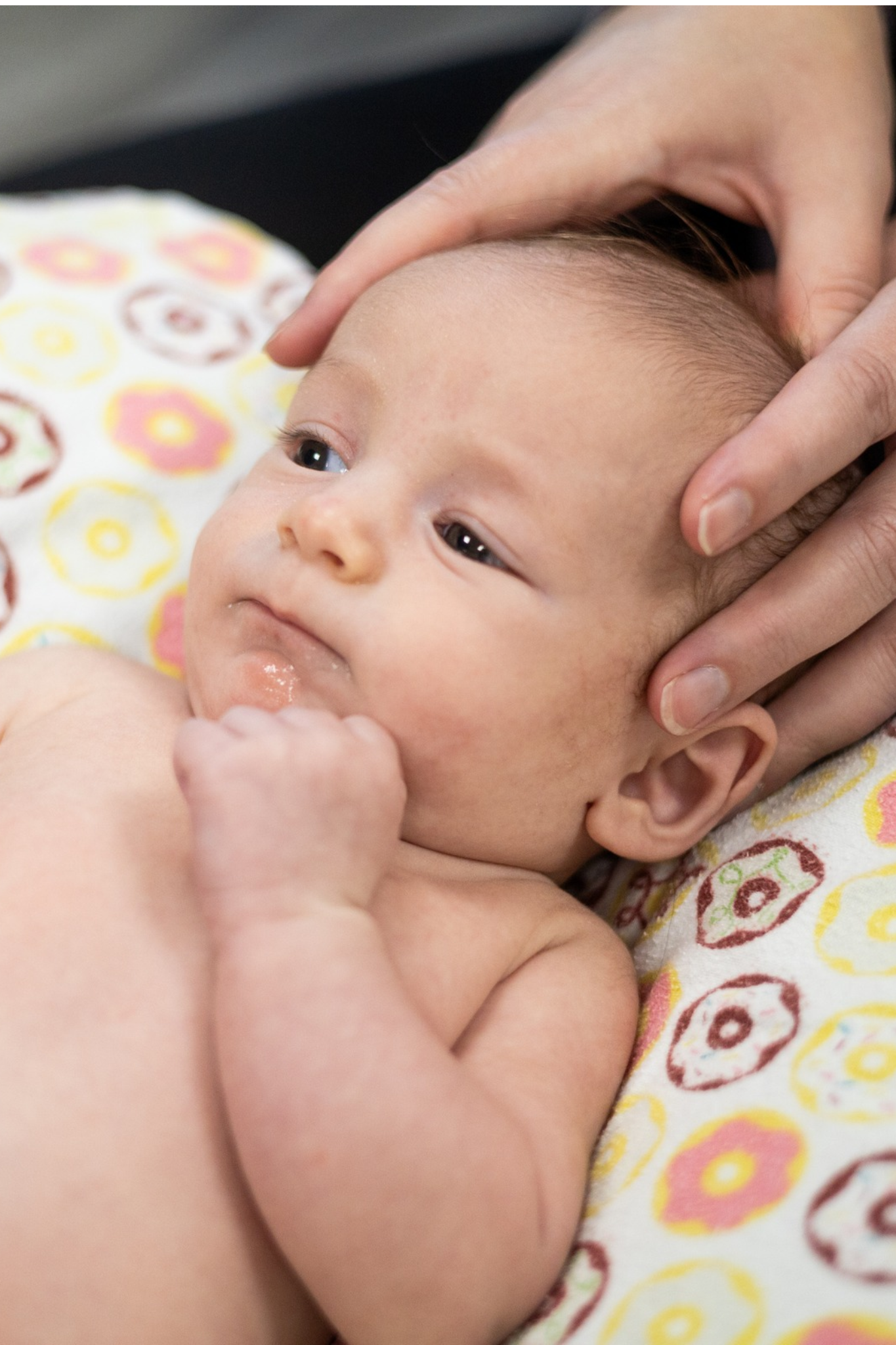
Gradually, you may notice your baby becoming more alert and responsive. They may:
Bring their hands toward their face or mouth
Move their arms and legs while lying on their back
Begin lifting their head during tummy time
Watch faces and follow moving objects with their eyes
Respond to familiar voices
React to loud sounds
Begin developing a social smile
The American Academy of Pediatrics notes that babies in the first few months gradually become more communicative and expressive, while their movement and hand-eye coordination continue developing.
These early interactions may seem small, but they are important opportunities for your baby to learn about the people and environment around them.
2-4 Months: More Control and More Communication
As babies approach four months, their movements often become more purposeful.
You may see your baby:
Hold their head more steadily
Push up on their forearms during tummy time
Bring their hands to their mouth
Reach toward or swipe at objects
Follow objects with their eyes
Smile and interact more with people
Make more cooing and gurgling sounds
Respond to sounds and voices
Your baby's growing interest in people is also part of development. Talking, singing, smiling, and responding to their sounds give them opportunities to practice communication and social interaction.
The National Institute of Deafness and Other Communication Disorder notes that between four and six months, babies may begin following sounds with their eyes, responding to changes in voice tone, laughing, and making a wider variety of sounds.
Your baby's ability to hold their head up during tummy time is also improving. Babies need more opportunity to practice this developing skill so try to set aside 5-6x in 10 min windows of time for you to help them engage in this activity. Many moms with more than one kid tell me they just don't have time to do this 5-6x. I see and hear you so here are a few ways you or your partner can fit it in.
Tummy Time Positions

Active tummy time entails rolling the baby in and out of tummy time with parents, older children, or pets helping to get babies attention and lifting the head to watch them.
Putting the baby on your lap while on their tummy
Resting the baby's body on your forearm while your hand provides support under the neck and chin. This is the position moms tell dads to stop holding the baby like a football. When done correctly you should see the baby relax and become curious about their surrounding.
4-5 Months: Reaching, Exploring, and Connecting
By six months, your baby may seem like a completely different baby from the newborn you first brought home.
Many babies become increasingly interested in reaching, grabbing, exploring, and interacting. According to the CDC common milestones by six months include:
Knowing familiar people
Enjoying looking at themselves in a mirror
Laughing
Taking turns making sounds with you
Making squealing sounds or blowing raspberries
Reaching for toys they want
Putting objects in their mouth to explore them
Rolling from tummy to back
Pushing up with straight arms during tummy time
Leaning on their hands for support while sitting
Begin to bringing their "Toes to their Nose" or "Happy Baby Pose"
You may also notice your baby becoming more interested in how things work. Dropping a toy, reaching for something just out of reach, grabbing an object, or bringing something to their mouth can all be ways of exploring their environment.
Looking Beyond the "Big" Movements
It's easy to focus on the exciting moments, your baby's first roll, first laugh, or first time reaching for a toy.

But development also happens through the smaller moments.
Maybe your baby is holding their head up for a few seconds longer during tummy time. Maybe they are beginning to turn toward your voice. Maybe they're making a new sound, watching your face while you talk, or figuring out how to bring their hands together.
These small changes are worth noticing.
Developmental research also suggest that babies benefit from opportunities to move, explore, and interact. One longitudinal study found associations between greater tummy-time exposure and stronger gross motor outcomes, while reading time was associated with several areas of developmental performance. The researchers emphasized that these were associations, not proof that one activity directly causes a particular developmental outcome.
The takeaway isn’t that parents need to create a perfect developmental program. It’s that ordinary movements can become opportunities for your baby to learn.
Simple Ways to Support Your Baby’s Development
You don’t need complicated equipment or a long list of activities to encourage healthy development. Try building simple opportunities into your baby’s everyday routine.
Give them opportunities to move: When your baby is awake and supervised, allow time for safe floor play and tummy time. Give them opportunities to move their arms and legs, reach for toys, and explore different positions appropriate for their stage of development.
The CDC specifically recommends playing with your baby on the floor or a play mat as a way to help them move, learn, and explore.
Talk, sing, and respond: Your baby’s early sounds are the beginning of communication. When they coo, babble, smile, or make noise, respond. Talk to them during everyday activities. Sing songs. Read together. Pause and give them a chance to respond.
These simple back-and-forth interactions help make communication a two-way experience.
Let them explore: Babies learn through their senses. They look at objects, reach for them, grasp them, and very often put them in their mouths. Offer safe, age appropriate objects for your baby to explore and give them opportunities to follow their curiosity.
Follow their interests: Your baby doesn’t need to be entertained every second. Sometimes the best activity is simply being on the floor together, watching each other, reaching for a toy, looking in a mirror, or listening to you talk.
Pay attention to what captures your baby’s attention and build to play around it.
What If My Baby Isn’t Doing Something Yet?
This is one of the most common sources of worry for parents.
At Optimal Health and Wellness our families under our membership care are able to discuss what milestones are coming up and also discuss how to help those milestones emerge when ready. Taking a proactive approach instead of reactive can help your baby to have a well regulated nervous system from the beginning.
A milestones list can be helpful, but it shouldn’t become a source of anxiety. Babies develop at different rates, and a single skill appearing later doesn’t automatically mean something is wrong. At the same time, your concerns matter.
Development is something healthcare providers monitor over time, and developmental screening can help identify concerns early. The CDC also recommends talking with your child’s doctor if they are not meeting milestones, if you have concerns, or if they lose skills they previously had.
If your baby was born prematurely, remember that corrected age may be important when considering developmental milestones. The CDC recommends using corrected age for babies born more than three weeks prematurely.
Your Baby Doesn’t Need to Race to the Next Milestone
The first six months aren’t about checking every box on a list.
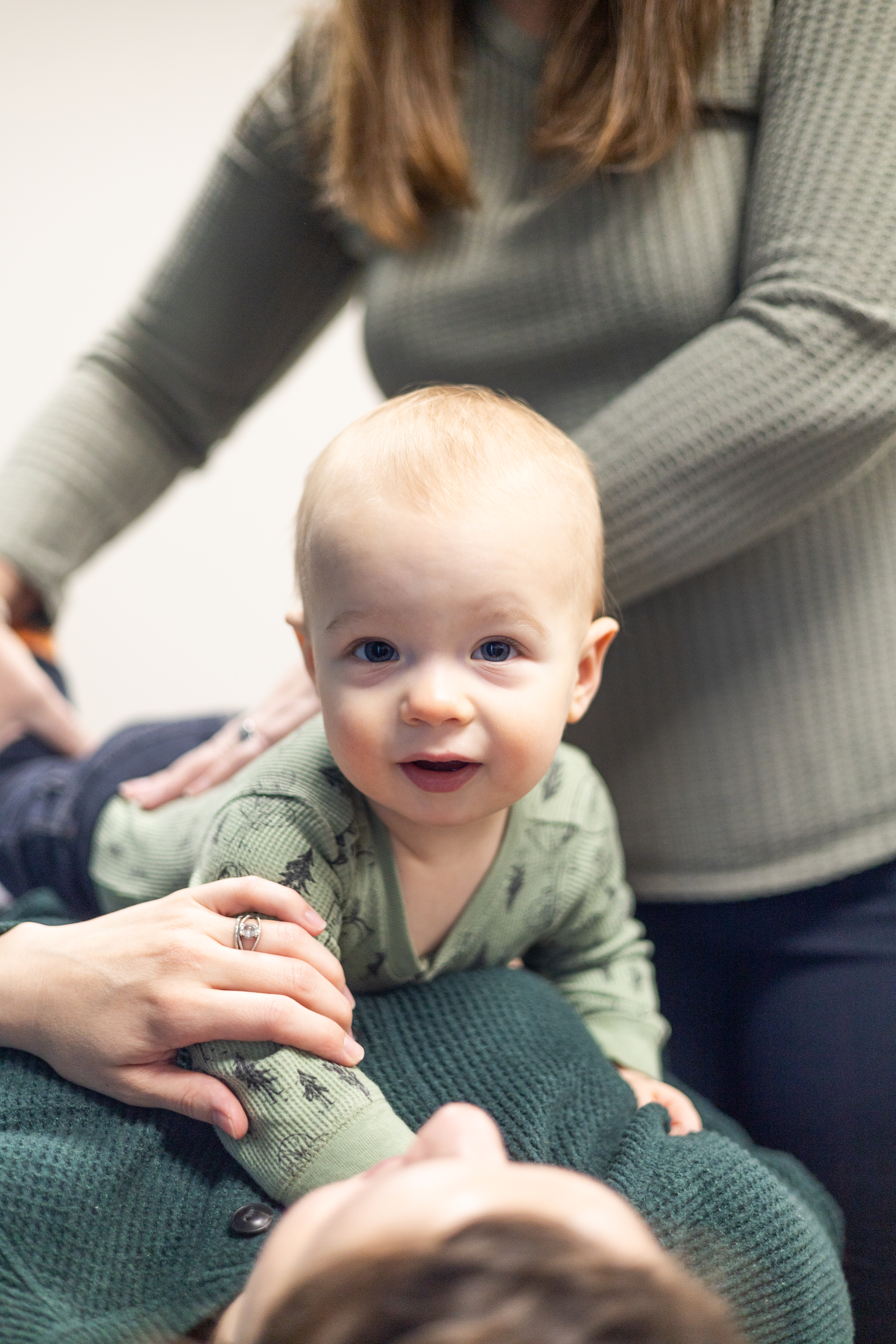
They’re about watching your baby gradually become more aware of their body, their surroundings, and the people who care for them.
A head lift becomes a stronger push during tummy time. A random sound becomes a back-and-forth conversation. Watching a toy becomes reaching for it. A tiny smile becomes laughter.
Those little moments are development, too.
So give your baby safe opportunities to move, explore, communicate, play, and connect and give yourself permission to enjoy the process.
Your baby’s development isn’t a race.
It’s a journey of many small discoveries, one milestone at a time.
Reference
Libs, S. (2025, season-02). Your baby’s movements are building their Brain–Literally. Pathways to Family Wellness, 85. https://pathwaystofamilywellness.org/childrens-health-wellness/your-babys-movements-are-building-their-brain-literally.html
LoRang, C. (2019, season-01). Building your baby from the ground up. Pathways to Family Wellness, 61. https://pathwaystofamilywellness.org/childrens-health-wellness/building-your-baby-from-the-ground-up.html
Mumma, L. (2019, season-01). On Their Own: How to Stop Interfering With Your Child’s Development. Pathways to Family Wellness. https://pathwaystofamilywellness.org/childrens-health-wellness/on-their-own-how-to-stop-interfering-with-your-childs-development.html
Allen, K. (2008, season-02). Playing is more than just fun: benefits of proper motion to develop healthy minds and bodies. Pathways to Family Wellness, 18. https://pathwaystofamilywellness.org/childrens-health-wellness/playing-is-more-than-just-fun-benefits-of-proper-motion-to-develop-healthy-minds-and-bodies.html
Sañudo-Diez, B. (2008, season-04). Baby crawling: How important it really is. Pathways to Family Wellness, 20. https://pathwaystofamilywellness.org/childrens-health-wellness/baby-crawling-how-important-it-really-is.html
Misirliyan, S. S., Boehning, A. P., & Shah, M. (2023, March 16). Developmental milestones. StatPearls - NCBI Bookshelf. https://www.ncbi.nlm.nih.gov/books/NBK557518/
Dosman, C. F., Andrews, D., & Goulden, K. J. (2012). Evidence-based milestone ages as a framework for developmental surveillance. Paediatrics & Child Health, 17(10), 561–568. https://doi.org/10.1093/pch/17.10.561
Carson, V., Zhang, Z., Predy, M., Pritchard, L., & Hesketh, K. D. (2022). Longitudinal associations between infant movement behaviours and development. International Journal of Behavioral Nutrition and Physical Activity, 19(1), 10. https://doi.org/10.1186/s12966-022-01248-6
Your Baby’s hearing and communicative Development Checklist. (2017, March 6). NIDCD. https://www.nidcd.nih.gov/health/your-babys-hearing-and-communicative-development-checklist
Eunice Kennedy Shriver National Institute of Child Health and Human Development - NICHD. (n.d.). https://www.nichd.nih.gov/health/topics/factsheets/infantcare
Developmental milestones: 0 to 6 months. (n.d.). https://www.nationwidechildrens.org/family-resources-education/health-wellness-and-safety-resources/helping-hands/developmental-milestones-0-to-6-months
Baby. (n.d.). HealthyChildren.org. https://www.healthychildren.org/English/ages-stages/baby/Pages/default.aspx
Developmental Milestones for Babies (6-12 months) | Coral Care Developmental Guides. (n.d.). https://www.coralcare.com/developmental-guides/milestones-6-12-months-babies
Professional, C. C. M. (2025, December 5). Baby developmental Milestones (Infant milestones). Cleveland Clinic. https://my.clevelandclinic.org/health/articles/22063-baby-development-milestones-safety
Ellis, R. R. (2025, June 29). Milestones for your baby’s first year. WebMD. https://www.webmd.com/parenting/baby/baby-first-year-milestones


