



How Pregnancy Can Affect Your Posture
How Pregnancy Can Affect Your Posture
Pregnancy changes more than the size of your belly. As your baby grows, your body continually adapts to changes in weight, balance, movement, and the way you distribute forces through your body.
These changes can affect how you stand still, walk, bend, sleep, and move throughout the day. You may notice more pressure in your lower back, changes in your walking pattern, or simply that positions that once felt comfortable no longer do.
The good news? These changes are often part of the body's natural adaptation to pregnancy. There isn't just one "perfect" pregnancy posture that every woman should try to maintain.
Why Does Pregnancy Changes Your Posture?
As pregnancy progresses, the growing uterus and changes in body mass alter your center of gravity. Your body responds by making adjustments throughout your spine, pelvis, hips, and legs to help you remain balanced.
Research shows that pregnancy can affect spinal curvature, balance, gait, and movement. However, these changes aren't identical for everyone. Studies have found considerable variation in how pregnant women adapt their posture and movement.
This is important because you may have heard that pregnancy automatically causes an exaggerated lower-back curve. While changes in lumbar posture can occur, research does not show one consistent spinal pattern across all pregnancies. Your body may use its own combination of strategies to adapt.
How Can Pregnancy Affect Your Posture?
1. Your Center of Gravity Changes

As your abdomen grows, more of your body's mass is positioned toward the front. Your body responds by adjusting how you stand and move so that you can maintain balance.
You might notice yourself leaning differently, changing your stance, or shifting your weight more frequently.
These aren't necessarily signs that your posture is "bad". They can be normal adaptations to your changing your body.
2. Your Walking Pattern May Change
Pregnancy can change the way you walk.
Some research has found changes such as shorter steps, slower walking speeds, longer periods with both feet supporting the body, and a wider base of support. These adjustments may help the body manage changes in balance and stability as pregnancy progresses.
A wider stance, for example, may look different from your usual walking pattern, but it can be one way your body adapts to a changing of gravity.
3. Your Spine and Pelvis Experience New Demands
Your spine and pelvis have to accommodate a growing uterus, changing your body proportions, and additional physical demands.
Some women experience change in the curves of their spine or pelvic position during pregnancy. However, research shows that these changes vary considerably from person to person. In fact, one systematic review found that pregnancy-related changes in spinal curvature were not consistent across studies.
This is one reason there isn't a single "correct" pregnancy posture.
4. Your Muscles and Joints May Work Differently
Pregnancy can change the demands placed on the muscles and joints that help support your body.
Your abdominal wall stretches as your uterus grows, while the pelvis and pelvic floor experience changing loads and pressure. These changes can influence how you perform everyday moments, including getting up from a chair, bending, lifting, reaching, and carrying.
The goal isn't to prevent your body from adapting. Instead, it is to learn how to support yourself as those adaptations occur.
Can Pregnancy Posture Cause Back Pain?
Back pain is common during pregnancy, but it's important not to oversimplify the relationship between posture and pain.
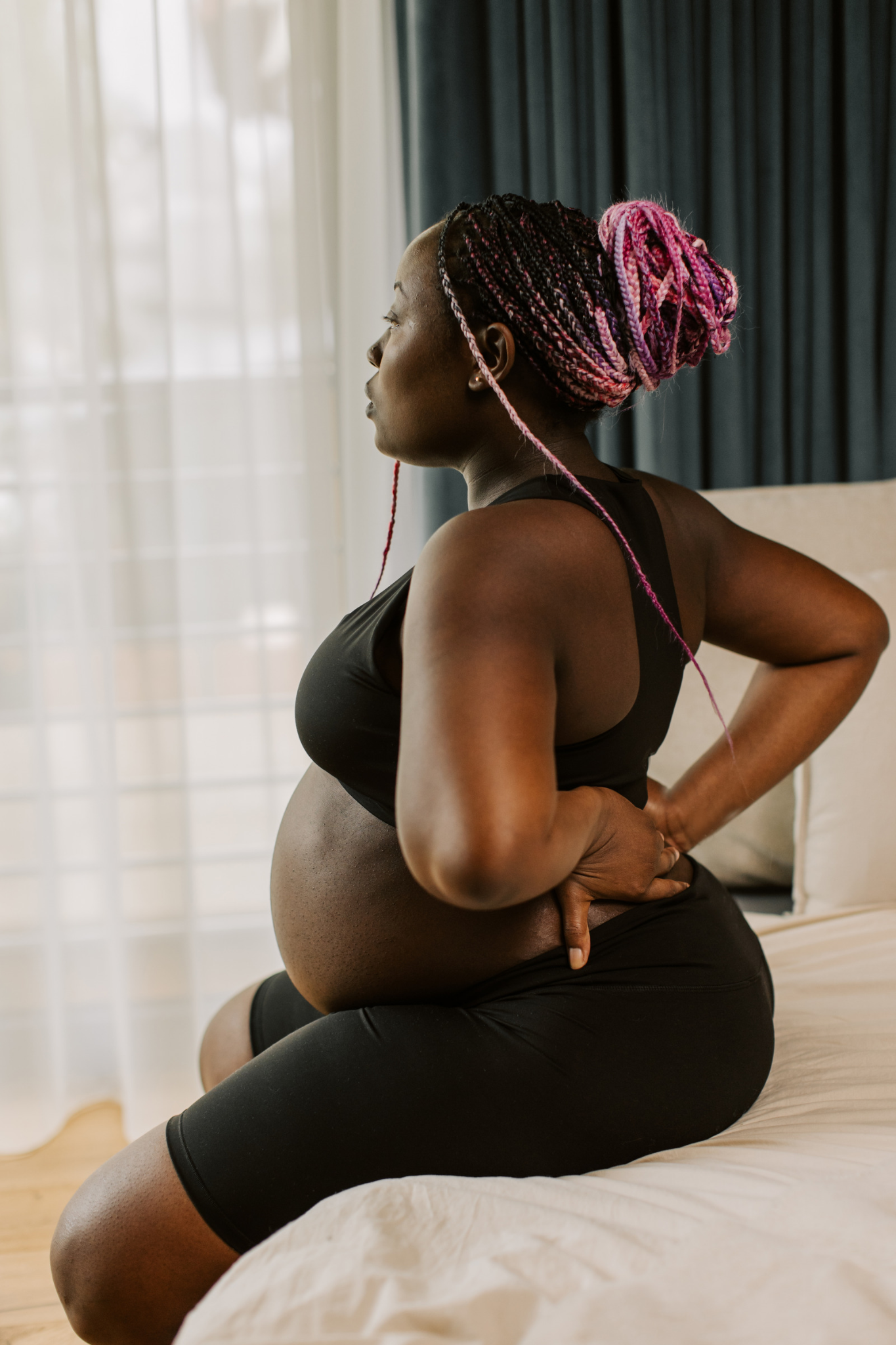
Pregnancy-related back discomfort can involve multiple factors, including increased body weight, changes in muscle function, hormonal changes, previous back pain, and the changing mechanical demands placed on the body.
Interestingly, a systematic review found that although back pain increases during pregnancy, it was not consistently correlated with changes in spinal curvature.
So if you're experiencing back pain, it isn't always due to a "bad posture". It could be your sign to gave your spine checked by one of our chiropractors at Optimal Health and Wellness who has had specialized training to work with pregnancy women.
Small Changes Can Make Everyday Movement More Comfortable.
You don't need to hold yourself rigidly upright all day. Instead, think about creating opportunities for movement, support, and position changes throughout your day.
A few practical strategies include:
Changes position regularly: Avoid staying seated or standing in one position for extended periods. Utilize an exercise ball to sit on to add movement to the hips and pelvis.
Use support when you need it: A supportive chair or small lumbar cushion may make sitting more comfortable.
Lift thoughtfully: Bend through your hips and knees, keep objects close to your body, and avoid twisting while lifting.
Bring things close to you: Rather than repeatedly reaching or bending forward, move closer to the object your using.
Choose comfortable footwear: Supportive shoes can help you feel more stable as your body changes.
Keep moving: Walking and pregnancy-appropriate physical activity can help you maintain strength and mobility when appropriate for your individual for your individual pregnancy.
Listen to your body: If a position causes pain, dizziness, or significant discomfort, change positions and seek appropriate guidance.
Good body mechanics aren't about achieving perfect posture. They're about finding ways to move that work for your changing body.
Posture is Individual During Pregnancy
One of the most important takeaways from the research is that pregnancy does not produce exactly the same biomechanical changes in every women.
A 2024 systematic review examining postural control during pregnancy found that research results were actually inconclusive, some studies found decreased balance, while others found no change or even improvement. The authors emphasized the variability in how women adapt to pregnancy.
Your posture may also change from one trimester to the next and even throughout the same day depending on fatigue, activity, positioning, and how your body is feeling.
Instead of asking, "What is the perfect pregnancy posture?, a better question may be:
"How can I support my body as it changes?"
How Can Prenatal Chiropractic Care Can Fit Into Your Pregnancy
Pregnancy is a time of significant physical adaptation, and individualized care can be one part of supporting your comfort and mobility.
At Optimal Health & Wellness, Drs. Riley and Sonda Powell, works with families during pregnancy and provides prenatal chiropractic care. A posture assessment can help you better understand how your body is adapting and identify areas that may benefit from individualized support.
Prenatal care can also work alongside other healthy habits, including appropriate movement, exercise, rest, and care from your pregnancy healthcare team.
If you're experiencing persistent or significant pain, changes in balance, or other symptoms that concern you, talk with your healthcare provider for an appropriate evaluation.
Your Body Is Designed to Adapt
Pregnancy doesn't simply change your body, it asks your body to continually adapt.
Your posture, balance, walking pattern, and movement may all change as your body grows. Those changes aren't automatically something that needs to be "fixed", understanding them can help you make informed choices about movement, support, and your overall prenatal care.
At Optimal Health & Wellness, we're here to help you understand those changes and support you through each stage of your pregnancy.
Interest in learning more about your pregnancy posture? Contact is to learn about prenatal chiropractic care and posture assessment in Tulsa, OK.
References
Ohm, J. (2009, season-04). Chiropractic care for an easier pregnancy and safer birth. Pathways to Family Wellness, 24. https://pathwaystofamilywellness.org/pregnancy-birth/chiropractic-care-for-an-easier-pregnancy-and-safer-birth.html
Ohm, J. (2023, season-01). The body adapts. Pathways to Family Wellness, 77. https://pathwaystofamilywellness.org/pregnancy-birth/the-body-adapts.html
Michaelson, A. (2020, season-04). Optimal Fetal Positioning: How Baby’s Position Can Alter Your Labor. Pathways to Family Wellness, 68. https://pathwaystofamilywellness.org/pregnancy-birth/optimal-fetal-positioning-how-babys-position-can-alter-your-labor.html
Hosaka, K. (2024a, season-04). Understanding fetal positioning and the pelvic journey during labor. Pathways to Family Wellness, 84. https://pathwaystofamilywellness.org/pregnancy-birth/understanding-fetal-positioning-and-the-pelvic-journey-during-labor.html
McCoy, L. (2024, season-01). Habits for a better pregnancy and an easier birth. Pathways to Family Wellness, 81. https://pathwaystofamilywellness.org/pregnancy-birth/habits-for-a-better-pregnancy-and-an-easier-birth.html
Conder, R., Zamani, R., & Akrami, M. (2019). The Biomechanics of Pregnancy: A Systematic Review. Journal of Functional Morphology and Kinesiology, 4(4), 72. https://doi.org/10.3390/jfmk4040072
Yoseph, E. T., Taiwo, R., Kiapour, A., Touponse, G., Massaad, E., Theologitis, M., Wu, J. Y., Williamson, T., & Zygourakis, C. C. (2025). Pregnancy-Related Spinal Biomechanics: A review of low back pain and degenerative spine disease. Bioengineering, 12(8), 858. https://doi.org/10.3390/bioengineering12080858
Schröder, G., Kundt, G., Otte, M., Wendig, D., & Schober, H. (2016). Impact of pregnancy on back pain and body posture in women. Journal of Physical Therapy Science, 28(4), 1199–1207. https://doi.org/10.1589/jpts.28.1199
Forczek-Karkosz, W., & Masłoń, A. (2024). Postural control patterns in gravid women—A systematic review. PLoS ONE, 19(12), e0312868. https://doi.org/10.1371/journal.pone.0312868
Professional, C. C. M. (2026, March 16). Pregnancy: Correct Posture & Body Mechanics. Cleveland Clinic. https://my.clevelandclinic.org/health/articles/6913-pregnancy-correct-posture--body-mechanics
Henry Ford Health. (n.d.). How Pregnancy Impacts Your Posture—And What to do About it. https://www.henryford.com/blog/2023/02/postpartum-posture
Sarkar, P. K., Singh, P., Dhillon, M. S., Bhattacharya, S., & Singh, A. (2022). Postural deviation in pregnancy. Journal of Family Medicine and Primary Care, 11(7), 3717–3725. https://doi.org/10.4103/jfmpc.jfmpc_1807_21
Pregnancy and Posture: PT tips for spring expecting moms. (n.d.). Rainey Pain & Performance. https://raineypainandperformance.com/pregnancy-and-posture-pt-tips-for-spring-expecting-moms
Chiropractor, D. C. (2025, March 19). Pregnancy posture problems: Causes, solutions, and care. Chatfield Family & Sports Chiropractic. https://www.chattychiro.com/pregnancy-posture-problems-causes-solutions-and-care/
How pregnancy changes your posture and spine. (2026, May 29). https://chirofamilywellnesscenter.com/blog/how-pregnancy-changes-your-posture-and-spine
Learning about posture and body mechanics during pregnancy | South County Health. (n.d.). https://schospitalib.staywellsolutionsonline.com/Bedside/3,ado2692
The impact of pregnancy on the pelvic floor. (n.d.). Rushpt. https://www.rushpt.com/why-choose-us/blog/the-impact-of-pregnancy-on-the-pelvic-floor/


