



Tongue Tie and Breastfeeding: Questions Parents Should Ask
Tongue Tie and Breastfeeding What Questions Should Parents Ask?
Breastfeeding can sometimes feel harder than expected. A baby may struggle to latch, make clicking sounds, feed for a long time, or leave a parent with ongoing nipple pain. When these concerns comes up, parents may wonder: Could tongue-tie be the reason?
Tongue tie, also called ankyloglossia, occurs when the lingual frenulum, the tissue connecting the underside of the tongue to the floor of the mouth, restricts tongue movement.
But seeing a frenulum or noticing a certain shape under the tongue does not automatically mean there is a problem. The important question is not only what the tongue looks like, but how it functions during feeding.
So, what should parents ask when tongue-tie is suspected.
1. Is My Baby's Tongue Actually Restricted?
A frenulum is a normal structure. The concern is whether it is restricting the tongue enough to affect function.
Some babies wit a visible tongue-tie breastfeeding without difficulty, while others may have functional challenges that aren't immediately obvious from appearance alone.
Rather than focusing only on whether the tissue looks tight or whether the tongue has a heart-shaped appearance, ask:
Can my baby lift the tongue?
Can the tongue move normally during feeding?
Can my baby maintain a deep latch?
Is the tongue able to help create an effective seal?
Appearance can provide clues, but function is an important part of the assessment.
2. How Is This Affecting Breastfeeding?

Parents may notice several signs when feeding isn't going well, including:
Difficulty achieving or maintaining a latch
Clicking or smacking sounds during feeds
Frequent popping on and off the breast
Long or tiring feeding sessions
Ongoing nipple pain or nipple distortion after feeding
Baby seeming hungry shortly after feeding
Concerns about milk transfer or weight gain.
These signs can occur with tongue-tie, but they are not specific to tongue-tie. Positioning, latch technique, milk supply, infant oral function, and other factors can also contribute.
That is why symptoms should be evaluated rather than assuming the frenulum is the main cause.
3. Has Someone Observed a Full Breastfeeding Session?
One of the most helpful questions a parent can ask is:
"Can you watch my baby breastfeed?
A feeding assessment can reveal things that aren't obvious form looking inside the baby's mouth. An experienced breastfeeding professional can observe:
Latch and positioning
Sucking and swallowing
Whether the latch becomes shallow
Whether milk transfer appears effective
How the baby's tongue is functioning during the feed
Whether the parent is experiencing pain
A comprehensive breastfeeding evaluation can help determine whether tongue restriction may be contributing to the problem or whether another issue should be addressed first.
4. Could Something Else Be Contributing?
This is an important question before deciding that tongue-tie is the explanation.
Breastfeeding difficulties can have multiple contributing factors. These may include positioning and latch, maternal milk supply, nipple anatomy, infant oral function, feeding skills, or other health concerns.
The American Academy of Pediatrics recommends a complete breastfeeding assessment before considering frenotomy for symptomatic ankyloglossia. In other words, finding a frenulum isn't necessarily the end of the evaluation, it is one piece of the bigger picture.
5. How Was the Tongue-Tie Assessed?

Parents can ask:
"How are you determining that the frenulum is restricting my baby's function?"
There is currently no universally accepted diagnostic method for ankyloglossia, and different assessment tools and classification systems are used.
Some providers use structured tools that consider both the appearance and function of the tongue. However, an assessment should not rely on appearance alone.
The goal is to determine whether there is meaningful functional restriction that is actually contributing to breastfeeding difficulty.
6. Do We Need Treatment Right Away?
Not every baby with tongue-tie needs a procedure. If breastfeeding is going well and the baby is growing appropriately, treatment may not be necessary. Even when breastfeeding is difficult, positioning and lactation support may improve feeding without a procedure.
This is why it can be helpful to ask:
"What can we try first, and how will we know it's working?"
The answer may include additional feeding support, monitoring, and follow-up before deciding whether further intervention is appropriate.
Another consideration is whether neck, jaw or cranial tension could be affecting the latch. Ties and lactation are one aspect but many times parents overlook tensions that could be present due to uterine position and birth interfering with normal mechanical processes that could be affecting the latch.
7. If Frenotomy Is Recommended, What Benefit Are We Expecting?
Frenotomy releases restrictive tissue beneath the tongue to improve its movement. When restricted tongue movement contributes to breastfeeding difficulties, a release may be considered as part of an individualized care plan.
Research has reported improvements in maternal improvements in maternal nipple pain, breastfeeding confidence, and milk transfer following tongue-toe release (Ghaheri et al., 2017). Other studies have reported improvements in feeding and additional functional concerns when release is combined with exercises or myofunctional therapy (Baxter et al., Zaghi et al., 2019). However, more research is needed to understand which patients benefit most and whether improvements last long term.
Here are some helpful questions to ask:
What specific feeding difficulties might the release address? Consider factors such as latch, milk transfer, feeding efficiency, and maternal discomfort.
How will we know whether the procedure is likely to help? Ask how tongue movement and feeding function will be assessed.
What benefits can we reasonably expect? Discuss which outcomes are supported by research or a practitioner's clinical experience and which remains less certain.
What are potential risks and alternatives? Make sure you understand the procedure, possible complications, and other approaches to supporting feeding.
What follow-up care will be recommended? Ask about lactation support, feeding assessment, and any exercises or other therapy recommended.
A tongue-tie release is not necessary for every baby with a visible restriction. The decision should be based on whether restricted tongue movement is affecting feeding and whether the expected benefits outweigh the risks for that baby.
8. Does the Procedure Have to Be Done With A Laser?
Parents may hear different recommendation about scissors, scalpels, or lasers.
Current evidence does not establish lasers as superiors to scissors for treating tongue-tie. The AAP specifically notes that there is no evidence supporting lasers over other methods.
The more important questions is whether the provider is appropriately trained, whether the procedure is actually indicated, and whether the family understands the expected benefits and risks.
9. What Support Will We Have Before and After?
A procedure, when appropriate, is only one part of the breastfeeding picture. Some babies may adapt quickly after a frenotomy, while others may need time and continued feeding support. Lactation support can help parents work on positioning, latch, milk transfer, and maintaining milk supply when feeding has been difficult.
Follow-up care can also help determine whether feeding has improved and whether additional support is needed. Recommendations for exercises or wound care should be discussed with the treating clinician and tailored to the individual baby.
If milk transfer is a concern, monitoring weight and developing an appropriate feeding plan may also be important.
Ask:
"Who will help us with breastfeeding before and after treatment, and how will we know whether feeding is improving?"
10. Who Should Be Party of My Baby's Care?
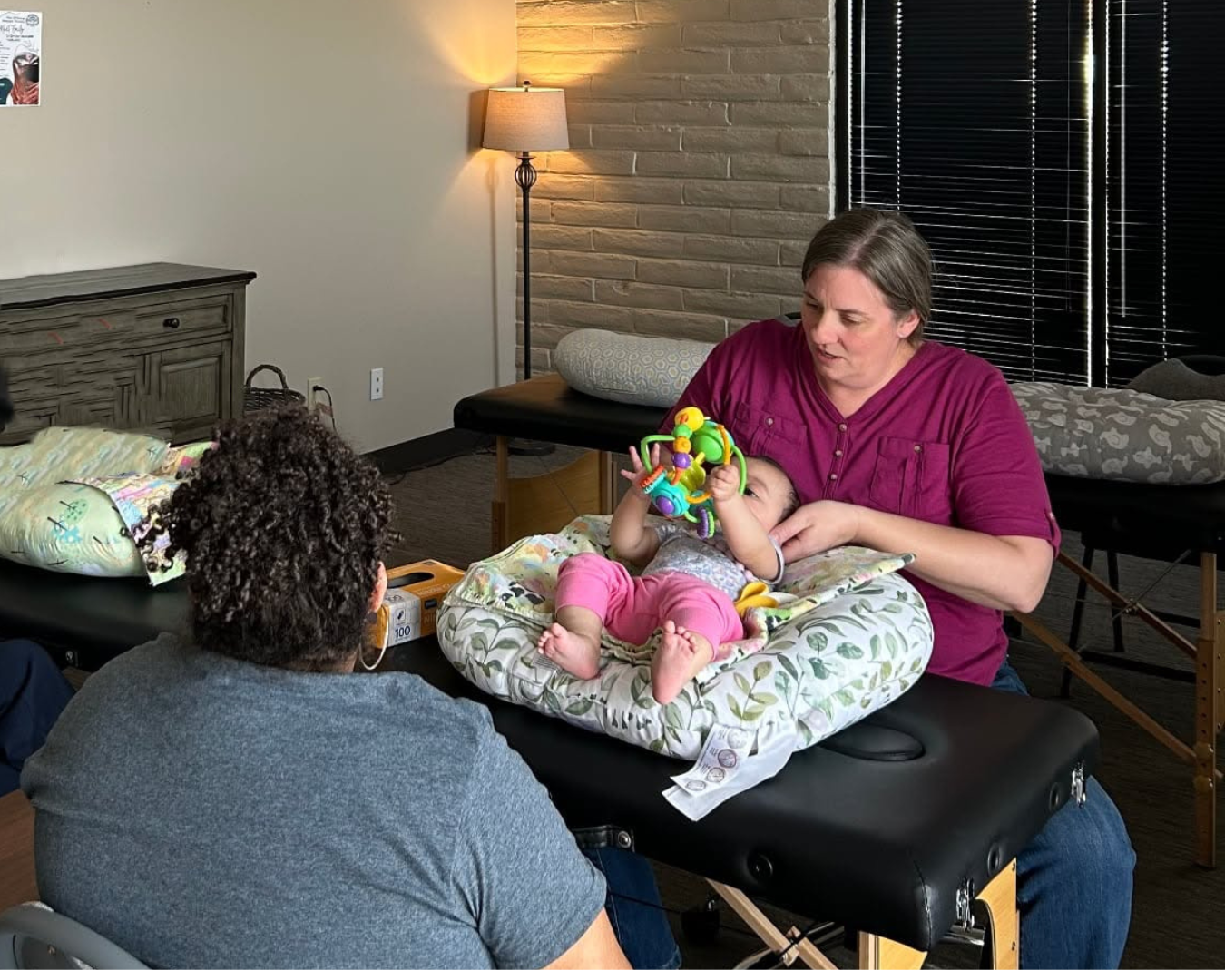
Tongue-tie and breastfeeding concerns don't always fit into on specialty.
Depending on the situation, care may involve on IBCLC, pediatrician, and an appropriately trained pediatric chiropractor who has had additional training to support pre and post release. Many dentists or ENTS have had post-graduate training to evaluate the frenulum and perform a procedure when indicated. Additional feeding or medical specialists may be involved as well.
For breastfeeding families, having someone who understands both infant feeding and lactation can be especially valuable.
What If You're Still Unsure?
If you're seeing a possible tongue-tie but aren't sure what it means, you don't have to figure it out from a photo or checklist alone.
Start with feeding concerns you're experiencing.
Is breastfeeding painful? Is your baby struggling to maintain a latch? Are feeds unusually long? Are you concerned about milk transfer or weight gain?
Those questions can help guide a more complete evaluation.
At Optimal Health & Wellness, Dr. Sonda, D.C., IBCLC, provides breastfeeding and lactation support through the Feeding Clinic. As an IBCLC, she can evaluate the breastfeeding experience, help identify feeding concerns, and help families determine what support or additional evaluation may be appropriate.
The Bottom Line
A tongue-tie diagnosis shouldn't be based on appearance alone. The more important questions are:
Is the tongue functionally restricted? Is the restriction affecting breastfeeding? Have other possible causes considered? And what options make sense for this particular baby and parent?
Getting a thorough assessment can give families clarity without assuming that every breastfeeding difficulty requires a procedure.
If breastfeeding isn't going as expected, you don't have to navigate the questions alone. Our office is here to help you understand what may be happening and determine the next step for you and your baby.

Reference
Hazelbaker, A. (2015, season-04). Modern myths about Tongue-Tie. Pathways to Family Wellness, 48. https://pathwaystofamilywellness.org/breastfeeding/modern-myths-about-tongue-tie.html
Goldach, G. (2024, season-01). Tongue to Toes: The Holistic Way to Resolve Tongue “Ties” at their Root. Pathways to Family Wellness, 81. https://pathwaystofamilywellness.org/childrens-health-wellness/tongue-to-toes-the-holistic-way-to-resolve-tongue-ties-at-their-root.html
Dorough, A. (2022, season-02). Tongue tie. Pathways to Family Wellness, 74. https://pathwaystofamilywellness.org/childrens-health-wellness/tongue-tie.html
Auerbach, A. (2015, season-04). Tongue-Tie: a holistic approach for breastfeeding infants. Pathways to Family Wellness, 48. https://pathwaystofamilywellness.org/breastfeeding/tongue-tie-a-holistic-approach-for-breastfeeding-infants.html
Becker, S., Brizuela, M., & Mendez, M. D. (2023, June 9). Ankyloglossia (Tongue-Tie). StatPearls - NCBI Bookshelf. https://www.ncbi.nlm.nih.gov/books/NBK482295/
Evans, L., Lawson, H., Oakeshott, P., Knights, F., & Chadha, K. (2023). Tongue-tie and breastfeeding problems. British Journal of General Practice, 73(732), 297–298. https://doi.org/10.3399/bjgp23x733221
O’Shea, J. E., Foster, J. P., O’Donnell, C. P., Breathnach, D., Jacobs, S. E., Todd, D. A., & Davis, P. G. (2017). Frenotomy for tongue-tie in newborn infants. Cochrane Database of Systematic Reviews, 2021(6), CD011065. https://doi.org/10.1002/14651858.cd011065.pub2
Tongue-Tie (Ankyloglossia). (2026, April 27). Cleveland Clinic. https://my.clevelandclinic.org/health/diseases/17931-tongue-tie-ankyloglossia
What does a tongue tie look like? Signs and how to tell | Colorado tongue tie. (n.d.). https://www.coloradotonguetie.com/post/what-does-a-tongue-tie-look-like-signs-and-how-to-tell
Team, K. T. (2026, May 26). How to Tell if Tongue-Tie is Affecting Breastfeeding? https://www.kidstoothteam.com/post/how-to-tell-if-tongue-tie-is-affecting-breastfeeding
Dentistry, S. P. (2023, April 26). 10 questions about tongue tie in nursing babies - Spinnaker Pediatric. Spinnaker Pediatric. https://spinpedo.com/blog/dental-emergencies/questions-about-tongue-ties/
Tongue-Tie and breastfeeding – children’s health. (n.d.). https://www.childrens.com/health-wellness/tongue-tie-and-breastfeeding
Tongue ties and lip ties - La Leche League USA. (2023, March 30). La Leche League USA. https://lllusa.org/tongue-and-lip-ties/
Ghaheri, B. A., et al. (2017). Breastfeeding Improvement Following Tongue-Tie and Lip-Tie Release: A Prospective Cohort Study. The Laryngoscope
Baxter, R., et al. (2020). Functional Improvements of Speech, Feeding, and Sleep After Lingual Frenectomy Tongue-Tie Release: A Prospective Cohort Study. Clinical Pediatrics
Zaghi, S., et al. (2019). Lingual Frenuloplasty With Myofunctional Therapy: Exploring Safety and Efficacy in 348 Cases. Laryngoscope Investigative Otolaryngology


